Spring Ideas

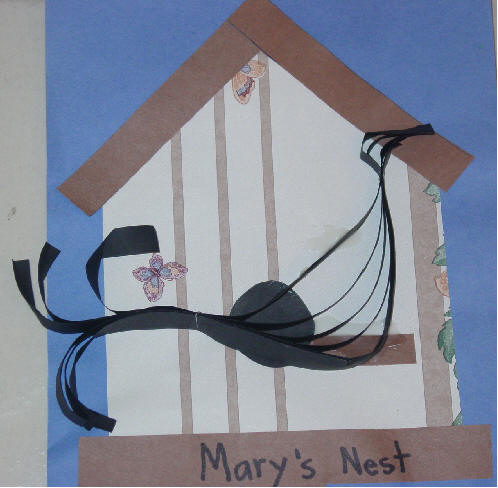
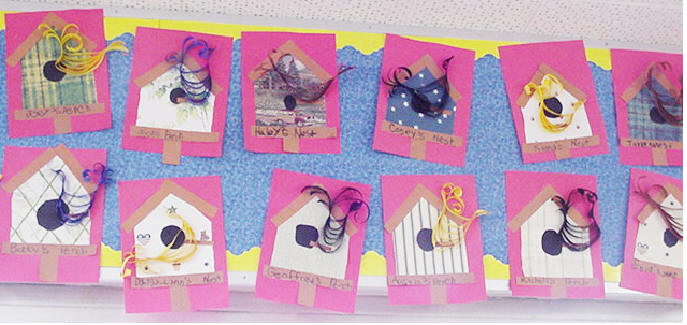
This is a fun project to do when spring arrives.  This is a close up of the project.  To see the bulletin board for more pictures, click on the photo below. 

Each child was given a birdhouse that had been traced on a wallpaper scrap.  The birds were made by stapling 6 strips of 1/2 inch x 12 inch pieces of construction paper.  They were stapled very close to one end for the head.  The bird is made by fanning out the strips to make the front of the bird.  Three of the feathers (shorter ones on the underneath side are turned down for the tail.  Three of the longer strips are pulled up to make the rest of the tail.  Hope this makes sense! 

The birdhouses were made using wallpaper book scraps.  We mounted the houses on a 9x12 piece of construction paper.  The hole on the birdhouse is approximately a  2 inch black circle.  The top frame of the house is 5 1/2 inches long and one inch wide.  The bottom frame where the name is written is 7 1/2 inches x 1 inch.  We attached a post to the bottom of the house that was 3 inches x 1 1/2 inches.  The longest part of the house is about 8 inches and it is about 6 1/2 inches wide.  Hope these measurements help you.


  Spring Birds

Click to enlarge photo.

These birds were created using the TLC method.  Each child was given a square or rectangle to cut the parts of the bird's body with the exception of the wings.  The wings were made by tracing each child's hand. 

Approximate sizes of paper:

Head  5 1/2 inch square

Body  12x7 inch rectangle

Breast  9x4 rectangle

Eyes  1 inch square for white and smaller for black

Beak  1 1/2 inch x 1 inch rectangle

These sizes can be scaled up or down depending the size that you want.


The Lion and the Lamb

This is one of my favorite March projects!  Each project was constructed on a paper plate and then they are stapled together back to back and hung.  The same pattern is used for the face on the lion and the lamb, but different colors of paper used.  The ears are shaped a little different for each.  The nose and the eyes are also the same pattern.  Cotton balls are glued all over the outside of the lamb's face.  Thick yarn is used for the lion's mane.  See graphing idea below that goes with this activity. 


 Click on the pattern to enlarge.


Lion or Lamb Day

We use this tally sheet to keep track of the weather during the month of March.  We make a tally mark next to the lion or the lamb.  At the end of the month, we make a graph to show how many lion or lamb weather days that we had. 


Spring Lamb


This lamb was also made on a paper plate.  The ears were made using a circle of white paper that has been folded over the head and glued to the front and back.  Cotton balls were used on the forehead.  The face was made with a marker. 


Another Cute Lamb

This lamb was made by tracing each child's hand on a piece of black construction paper.  Cotton balls are glued all over the body and part of the thumb.  The fingers are used for the lamb's legs.  A little bow is attached to the neck of the lamb.


Clothespin Lamb Idea

Attach two clip clothespins to a tongue depressor as shown below.  Paint the head and legs black or color them with a permanent marker.

  Glue cotton all over the lamb's body, leaving just the legs and the head peeking out.   

Glue an eye (paper-punch dot or wiggle eye) to each side of the head. 


 Pop Out Spring Flowers

This is an old sample, but hopefully you will be able to see it for directions.  Kindergarteners will need a little help with this, you can do in a small group setting.  We usually do these with our third grade reading buddies. 

First, we draw a large flower that touches the bottom of the page.  Then the flower is outlined in crayon with different spring colors.  This continues all the way to the borders. 

The flower is cut out starting at the very bottom of the page in order to lift the complete flower off the page.  The background part of the project (outlined part) is mounted on a contrasting piece of construction paper to make a border all around.  Then the flower is attached to the center (where it was removed) with little "W" shaped tabs.  This zig zag shaped tab allows the flower to POP OUT.  Glue one end of the tab on the backing of the project (blue in photo) and the other end of the tab is attached to the flower.  These look really cute on the bulletin board for spring!